If you’ve spotted thinning leaves or small D-shaped holes in an ash tree on your Fredericton property, you’re likely dealing with emerald ash borer, and the decisions you make in the next few weeks matter more than the ones you make after the tree is already bare. This guide covers the real warning signs, what treatment actually costs, and how to tell when removal is the safer call.
Key Takeaways
- Emerald ash borer (EAB) has been established in Fredericton since 2021, and the city’s own beetle traps have gone from catching one or two insects a season to 20 to 50 per trap.
- Look for D-shaped exit holes, thinning canopy, and epicormic shoots low on the trunk, but treat any single sign with caution, since drought and storm damage can mimic it.
- Treatment with TreeAzin can protect a structurally sound tree, but it isn’t cheap or permanent. Expect a recurring cost every two years, not a one-time fix.
- Removal becomes the safer call once decay, cracking, or major deadwood shows up over a driveway, roofline, or walkway.
- Our ISA certified arborists can tell you, tree by tree, whether treatment still makes sense or whether you’re better off planning a controlled removal now.
Why Emerald Ash Borer Is a Real Problem for Fredericton’s Trees
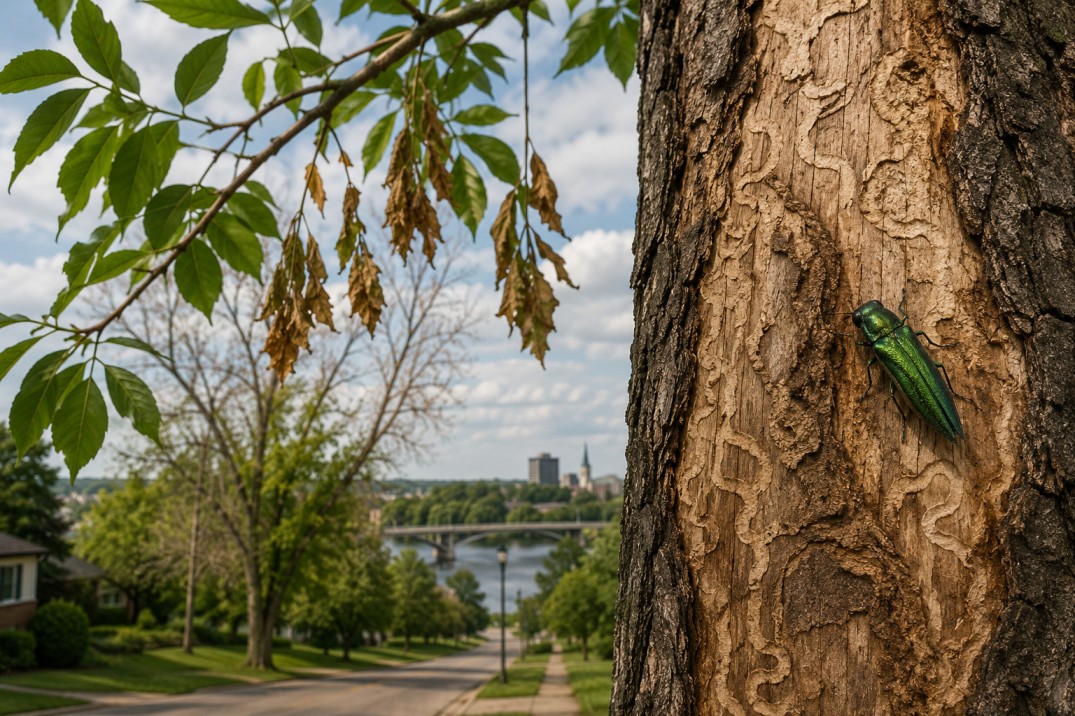
Emerald ash borer is a small, metallic-green beetle whose larvae do the actual damage. They tunnel beneath the bark in winding, S-shaped galleries that cut off the tree’s ability to move water and nutrients, which is why an ash can look almost normal from the curb while it’s already failing underneath.
The beetle reached Fredericton in 2021, after moving through Edmundston (2018) and Oromocto and Moncton (2019). The city had already started preparing years earlier: in the lead-up to the beetle’s arrival, forestry crews inoculated 21 ash trees in Odell and Wilmot Parks with TreeAzin as a precaution, at a cost of roughly $4,200 to $6,300 for that first batch. Odell Park alone holds an estimated 10,000 ash trees, with another 2,400 or so lining city streets, which gives some sense of what’s at stake across the city, before you even get to private yards.
Once EAB takes hold in an area, provincial data puts ash mortality at around 99% within eight to ten years if nothing is done. That’s the timeline worth keeping in mind: this isn’t a pest that kills a tree in one season, but it also isn’t one that goes away on its own.
Signs of Emerald Ash Borer to Look For
No single sign confirms an infestation. Several appearing together is what should prompt a closer look.
D-shaped exit holes and bark damage.
Adult beetles leave exit holes roughly the width of a grain of rice, D-shaped rather than round. You may also see bark splitting or peeling in patches, and increased woodpecker activity, since birds strip bark hunting for larvae underneath.
Canopy dieback.
This typically starts at the top of the crown and works downward: a thinning, patchy look compared to healthy ash nearby, with individual branches dying off. Dead limbs hanging over a driveway or walkway are worth flagging even if the rest of the tree still looks reasonable.
Epicormic shoots.
These are new sprouts pushing out low on the trunk, usually below where the canopy has thinned. They’re the tree trying to compensate for lost leaf area, not a sign of recovery. Combined with exit holes and dieback, they usually mean the infestation has been active for a while already.
In our experience assessing ash on residential lots around the city, the combination that gets missed most often is a slightly sparse upper crown paired with a few low shoots near the base. Homeowners tend to notice one or the other, not both together, which is exactly the pairing that matters.
Symptoms Beneath the Surface
The larvae feed in the cambial layer, the thin band of live tissue just under the bark, for one to two years before obvious external symptoms show up. That lag is why a tree can decline for a full season or two with only subtle clues: slightly smaller leaves, a few dead branch tips, reduced twig growth. By the time bark is visibly loose or the crown is clearly sparse, the infestation is usually well established.
This matters for diagnosis, too. Not every ash showing stress has EAB. Drought, root compaction from construction, or other borers can cause similar symptoms. That’s part of why a physical inspection, not a description over the phone, is the more reliable way to confirm what’s going on.
Can an Infected Ash Tree Be Saved?
Sometimes, yes, particularly when the tree is still structurally sound, retains most of its canopy, and is valuable enough (shade, size, location) to justify ongoing care. Treatment doesn’t undo existing damage or guarantee an indefinite lifespan; it slows further larval damage enough to keep a healthy tree healthy.
TreeAzin is the treatment most commonly used in Fredericton. It’s a systemic insecticide, injected at the base of the tree, built around azadirachtin, a compound derived from the neem tree. It’s taken up through the tree’s vascular system, where it works by killing larvae and reducing beetle fertility, rather than repairing any existing wood damage. Applications are typically needed every two years, so the real comparison isn’t “treat vs. do nothing once.” It’s the ongoing cost of treatment over the tree’s remaining life versus the eventual cost of removal.
Trunk diameter matters here too: a tree with extensive dieback already may not move the product effectively through its system, which is a big part of why earlier treatment tends to work better than treatment started after a tree is already in visible decline.
When Should an Ash Tree Come Down Instead?
Removal generally makes more sense once you’re seeing structural compromise on top of the beetle damage: trunk cracks, decay, cavities, or major deadwood, especially anywhere near a house, driveway, power line, or path. A tree doesn’t need to be fully dead to justify removal. Waiting for visible collapse usually means losing control over the timing and cost of the job, and raises the odds of storm-related failure in the meantime.
Location changes the calculation more than most homeowners expect. A declining ash in the back corner of a large lot can often be left alone or monitored longer than a similar tree 15 feet from a bedroom window. If you’re unsure which category your tree falls into, a professional tree risk assessment is the fastest way to find out, and our diseased tree removal guide walks through how we tell a treatable decline from structural failure.
What Ash Tree Removal Actually Costs in Fredericton
Prices vary by size, condition, and access, but here’s a realistic range based on current regional pricing:
| Tree size | Typical cost range (CAD) | Notes |
|---|---|---|
| Small ash (under 30 ft) | $250 to $600 | Easy access, minimal rigging |
| Average ash (30 to 60 ft) | $900 to $1,300 | Most common residential job |
| Large ash (60 to 80 ft) | $1,300 to $2,500+ | May require a crane or bucket truck |
| Hazardous / structurally compromised | $2,000 to $3,600+ | Dead or brittle wood, work near structures or lines |
Dead or EAB-weakened ash tends to sit at the higher end of its size bracket, since brittle wood makes controlled dismantling slower and often requires extra rigging or aerial equipment rather than a straightforward fell. For a fuller breakdown of what drives tree removal pricing in general, see our tree removal cost guide. Fredericton also has tree bylaws that may require a permit for larger removals, worth confirming before work is scheduled, not after.
Get a written estimate from a professional Fredericton tree removal service, and make sure it specifies whether stump grinding, branch chipping, and full site cleanup are included. These are commonly quoted as add-ons rather than bundled into the base price.
Treat or Remove? A Simple Way to Decide
- Confirm the tree is ash and check for EAB signs (exit holes, dieback, epicormic shoots).
- Estimate how much healthy canopy remains and inspect the trunk for cracks, cavities, or decay.
- Note what’s nearby: house, driveway, fence, power line, path.
- Compare the ongoing cost of treatment (roughly every two years) against a one-time removal and replanting cost.
None of this replaces an in-person look, but it gives you and an arborist the same starting point for the conversation.
Not sure which side of that line your tree is on? Contact Ideal Tree Service for a free ash tree assessment. We’ll tell you honestly whether treatment still makes sense or whether removal is the safer call, no upsell either way.
Why an Arborist’s Assessment Is Worth It
Our ISA certified arborists look at more than just EAB symptoms. Branch unions, root flare, lean, and existing decay all factor into whether a tree is a reasonable candidate for treatment or a near-term removal risk. That combined view matters because beetle damage and pre-existing structural weakness often show up together, and treating the beetle problem alone doesn’t fix a cracked trunk.
Every assessment ends with a clear recommendation: monitor, prune deadwood, treat, or remove, not just a list of concerns.
What to Do If You Suspect an Infected Ash
- Keep people and vehicles clear of any tree with obvious dead limbs or a visible lean. If a limb has already come down or the tree is leaning toward a structure, that’s an emergency tree removal situation, not a wait-and-see one.
- Photograph the trunk, canopy, and any exit holes so you have a record before and after any work.
- Avoid moving ash firewood off your property. This is one of the main ways EAB spreads to new areas, and CFIA movement restrictions apply in regulated zones.
- Book an arborist assessment rather than guessing from the ground; early treatment decisions are more likely to save a tree than late ones.
After Removal: Stump, Site, and Replanting
Once a tree is down, most jobs include chipping the branches, sectioning the trunk, and hauling material off-site. A leftover stump is more than a cosmetic issue: it can become a tripping hazard, interfere with mowing, and even attract new pests, which is why leaving a stump behind causes problems worth avoiding.
When choosing a replacement, diversity is the practical lesson from EAB itself: a single species across a whole yard or street is exactly what let this beetle do so much damage so fast. Species like red maple, honeylocust, or native oak are common substitutes in this climate zone, but your arborist can recommend species suited to your specific soil and light conditions.
Frequently Asked Questions
How do I know if a tree on my property is actually an ash?
Ash trees have opposite branching (branches emerge directly across from each other, not staggered), compound leaves with 5 to 9 leaflets, and diamond-patterned bark ridges on mature trees. If you’re unsure, an arborist can confirm the species in a few minutes on-site.
Can EAB symptoms be confused with something else?
Yes. Drought stress, root damage from nearby construction, and other wood-boring insects can all cause thinning leaves and dead branch tips. Multiple signs together (exit holes plus dieback plus epicormic shoots) are far more reliable than any one symptom alone.
Is treatment worth it for every infected ash?
No. Treatment tends to make the most sense for a tree with substantial healthy canopy remaining, a sound trunk, and low structural risk. A tree with extensive dieback or existing decay is usually a better candidate for planned removal.
How often does a treated ash need to be reassessed?
TreeAzin applications are typically repeated every two years, and a treated tree should be checked after any major wind, ice, or snow event in between, since storm damage can change the risk picture regardless of the treatment schedule.
Can I prune the dead branches myself?
Removing small deadwood at ground level with hand tools is usually fine. Anything requiring a ladder or chainsaw work overhead on a weakened tree should go to a professional. Brittle, EAB-damaged wood fails less predictably than healthy wood.
Can I move ash firewood from an infested area?
Generally no. Moving ash wood is one of the main ways EAB spreads between regions, and CFIA regulated-area rules restrict this movement in parts of Atlantic Canada. Check current CFIA guidance for your specific area before transporting any ash wood.