
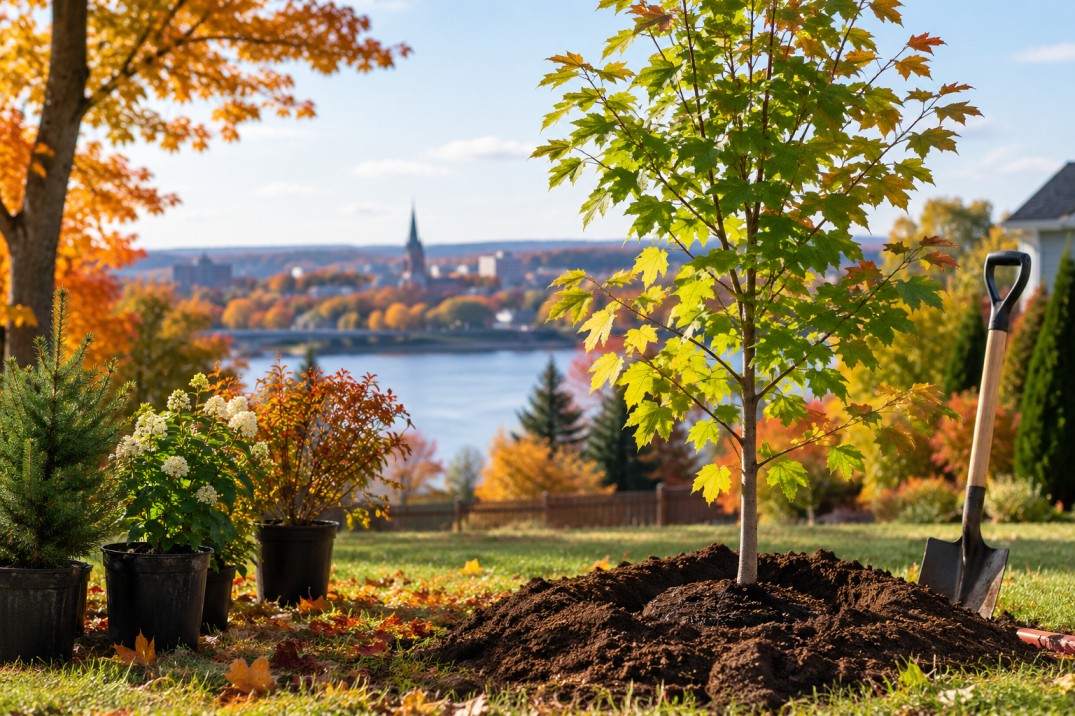
If you’re thinking about planting a tree on your Fredericton property this fall, choosing the right trees to plant in Fredericton matters more than simply selecting a tree that looks good at the nursery. We get asked about this constantly, usually from homeowners standing in a garden centre aisle trying to picture how a two-foot sapling will look in twenty years, and the honest answer is that it depends heavily on where in the yard it goes, not just which species is on the tag.
Fredericton’s urban forest faces several real, documented challenges: invasive pests, a shifting climate, limited planting space in newer subdivisions, and a need for greater tree diversity after decades of leaning on a small handful of species. The City of Fredericton has responded with its Community Tree Program and a newly adopted 25-year Urban Forest Strategy, developed with Stantec Consulting, that sets out how the city will protect and grow its tree canopy as the population grows and development continues.
For homeowners planning a new tree this fall, that’s an opening to do more than add shade to the backyard. Choosing a species that’s genuinely suited to Fredericton’s soil, climate and pest pressures, rather than whatever looked appealing at the store, makes the difference between a tree that thrives for decades and one that struggles from the start.
Why Fall Is a Good Time to Plant Trees in Fredericton
Fall is generally considered one of the better planting windows in this region, and there’s a practical reason for it. As soil temperatures stay warm into October while air temperatures drop, a newly planted tree can put its energy into root growth instead of fighting summer heat stress. That head start on the root system means the tree is better positioned to handle next summer’s dry stretches, often with less supplemental watering than a spring-planted tree of the same size would need.
That said, timing is only one factor. In our experience walking properties around Fredericton and the surrounding communities, the biggest mistake isn’t planting at the wrong time of year, it’s planting the wrong species in the wrong spot. Soil drainage, available sunlight, mature canopy width and proximity to structures all matter more than the calendar date.
Why Native Trees Matter in Fredericton
Native trees are adapted to the specific climate, soil chemistry and pest pressures of the region they evolved in, which generally means less irrigation, fewer chemical inputs, and stronger long-term survival than an unfamiliar species trucked in from a different growing zone.
The City of Fredericton has stated that the overwhelming majority of the trees it plants are North American native species, and it’s backed that up with real infrastructure: a dedicated tree nursery, opened in 2024, where staff grow seedlings from seed collected locally around Fredericton rather than buying stock shipped in from out of province. Species currently being propagated from that local seed include white spruce, sugar maple, black walnut and red oak, the same species we most often recommend when a residential planting site has the right conditions for them.
Diversity matters just as much as native origin. Leaning too heavily on one or two species is what makes an urban forest vulnerable when a single pest or disease takes hold. Fredericton has lived through this twice already: the city known historically as the “City of Stately Elms” lost most of its elm population to Dutch Elm Disease starting in the 1950s, and more recently, the Emerald Ash Borer, an invasive beetle capable of killing an ash tree within a few growing seasons, was confirmed in the city in 2021. Ash currently makes up roughly 12 percent of Fredericton’s urban canopy, which gives some sense of scale for what a single pest can put at risk when a canopy isn’t diversified. If a tree shows signs of serious disease or decline, professional tree assessment can help determine the right next step.
7 Native or Locally Appropriate Trees to Consider for a Fredericton Property
Not every tree belongs in every yard. Below are seven species that generally perform well in this region, along with the site conditions each one actually needs, because a tree that’s “native” isn’t automatically the right choice for a specific lot.
1. Red Oak
Red oak is one of the larger native species suited to Fredericton-area landscapes, and it’s one of the species the city is now growing from locally collected seed in its own nursery. Left with room to develop, it becomes a substantial shade tree that supports a wide range of wildlife. It’s a poor fit for tight urban lots, though, the root system and canopy both need significant lateral space, and we regularly see red oaks planted too close to foundations that end up needing corrective pruning years later.
Best for: Larger residential properties with room for a full mature canopy.
Consider: Its eventual size before planting anywhere near a house, driveway, or overhead line.
2. Sugar Maple
Sugar maple is another species Fredericton’s Parks and Trees Division is now propagating from local seed. It provides strong shade and reliable fall colour, but the gap between its nursery size and its mature size is significant, a maple that looks proportionate to a young tree at planting time can dwarf a small lot within fifteen to twenty years.
Best for: Properties with enough clearance for a large shade tree.
Consider: Distance from buildings, driveways, and overhead infrastructure.
3. Black Walnut
Black walnut is a long-lived native hardwood that the City has specifically prioritized for its local seed-collection and nursery program. It develops a broad canopy and a deep taproot over time, and it needs open ground to do that properly, walnuts planted in cramped sideyards tend to develop lopsided canopies as they reach for light.
Best for: Larger lots where a long-lived shade tree is the goal.
Consider: Fallen nuts and root spread can affect nearby garden beds, driveways and walkways as the tree matures.
4. White Spruce
White spruce is another species prioritized in the city’s own nursery program, and it’s a genuinely useful roadside option because of its salt tolerance, something that matters in a New Brunswick winter with regular road salting. As an evergreen, it also provides structure and wind screening through the winter months when deciduous trees are bare.
Best for: Larger properties wanting year-round screening or a windbreak.
Consider: Mature height and spread, particularly near roads or driveways where salt spray is a factor.
5. Balsam Fir
Balsam fir is New Brunswick’s official provincial tree, and it grows naturally in forested pockets around Fredericton, including Odell Park. It’s genuinely tolerant of less-than-ideal soil and offers valuable shelter and nesting habitat, which makes it a solid choice where homeowners want a hardy evergreen with real regional character rather than an imported ornamental conifer.
Best for: Properties wanting a hardy, low-maintenance native evergreen.
Consider: It needs adequate sunlight and room for its conical mature form, it won’t thrive crowded against a fence line.
6. Silver Maple
Silver maple tolerates flood-saturated soil better than almost any other tree on this list, with a sprawling root system that helps stabilize soil and reduce erosion along riverbanks and low-lying ground, relevant for the parts of Fredericton close to the Saint John River. It also grows fast, which is an advantage for homeowners who want shade sooner rather than later.
Best for: Yards with wetter soil or property near a watercourse or floodplain.
Consider: Fast growth and a large mature footprint mean it needs generous clearance from foundations and septic infrastructure.
7. Eastern Hemlock
Eastern hemlock is a long-lived, shade-tolerant native conifer, with specimens in Fredericton’s Odell Park estimated at over 500 years old. It’s one of the few trees on this list that genuinely performs well in partial shade, which makes it useful for yards where other species would struggle under mature tree cover.
Best for: Properties with dappled or partial shade wanting a long-term evergreen.
Consider: The city is actively monitoring for Hemlock Woolly Adelgid, an emerging pest threat in the region, so a newly planted hemlock is worth checking periodically for early signs of stress, something a routine tree risk assessment will pick up before it becomes a bigger problem.
Don’t Choose a Tree Based Only on Its Appearance
One of the most common mistakes we see is a homeowner choosing a tree because it looked good at the garden centre, without factoring in what that tree becomes in twenty or thirty years. A three-gallon pot doesn’t telegraph a forty-foot canopy.
Before planting, it’s worth working through the practical questions: How tall and wide will the tree get at maturity? How much direct sunlight does the planting spot actually receive through the day? Is the soil consistently wet, dry, or well drained? How close is the site to the house, a driveway, a walkway, or overhead power lines? Are there already several trees of the same species nearby, which would work against diversity rather than for it?
The goal isn’t just to plant a tree, it’s to plant the right tree in the right spot, which is the single biggest predictor of whether it’s still healthy in year twenty.
Fredericton Needs More Tree Diversity
Fredericton’s street tree inventory includes more than 80 species across roughly 21,000 street trees, data the Parks and Trees Division uses to track tree health and flag where species diversity is thin. That inventory exists precisely because of what’s already happened here: Dutch Elm Disease decades ago, and Emerald Ash Borer more recently, both moved through Fredericton’s canopy faster because so much of it relied on a small number of species. The city is now also monitoring for Oak Wilt and Hemlock Woolly Adelgid as emerging risks.
The practical takeaway for a homeowner is straightforward, planting a broad mix of suitable species on your own property helps prevent an entire neighbourhood block from being vulnerable to a single pest. If a mature ash tree does need to come down because of Emerald Ash Borer damage, a certified tree removal crew can usually tell fairly quickly from canopy dieback and bark splitting whether the tree is salvageable or not, which is worth confirming before assuming the worst.
Avoid Planting an Invasive Species
Growing well in Fredericton doesn’t automatically make a species a good long-term choice for the local environment. It’s worth checking a species’ actual origin before buying, rather than relying on a nursery tag that just says “hardy” or “low maintenance”, those terms describe how easy a tree is to keep alive, not whether it belongs in a Maritime ecosystem.
This matters more, not less, going forward. Fredericton’s own Urban Forest Strategy notes that as the climate shifts, conditions are expected to become less suitable for some native species while becoming more suitable for others, including species from further south. That’s part of why species selection today is worth doing carefully rather than defaulting to whatever’s easiest to find.
Where Should You Plant a New Tree?
Planting location can matter as much as species choice, and a tree that’s appropriate for a large rural property can be completely wrong for a small urban lot.
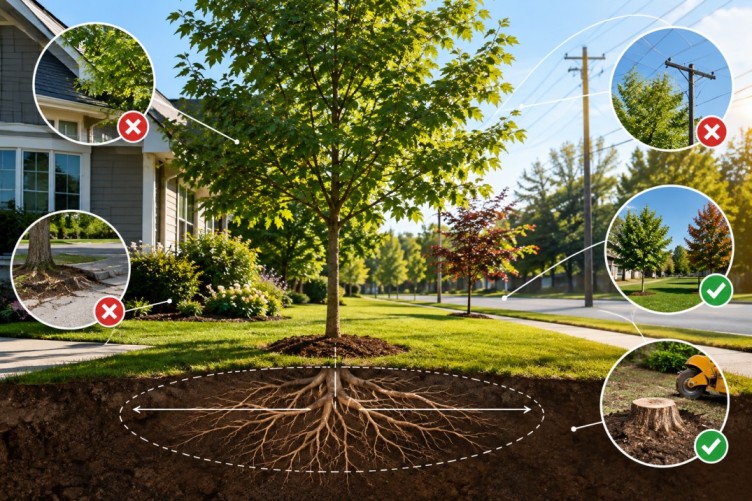
Leave real room for the mature canopy and trunk diameter, a tree planted too close to a house tends to eventually conflict with the roofline, siding or windows, not just at ground level. Account for both canopy and root spread near driveways and walkways rather than squeezing a tree into a narrow gap because it’s convenient today. Always check overhead before digging, since a small sapling can grow directly into power lines within a decade. If there’s already a mature tree nearby, give the new planting enough separation to avoid a crowded canopy competing for the same light and water, and if that existing tree is storm-damaged, hollow, or clearly declining, it’s often worth arranging an emergency tree removal or a standard removal before the new tree goes in, rather than planting next to a hazard.
If you’re replacing a tree that was previously taken down, note that the old root system usually needs to be dealt with first, stump grinding clears the way so the new tree’s roots aren’t competing with old decaying wood underground.
Fredericton also has specific rules around trees on public property, set out in the city’s Tree Management Bylaw. Trees on City-owned boulevards and rights-of-way are managed at the city’s discretion, so it’s worth confirming what’s permitted before planting anywhere near the street line.
Should You Plant a Large Tree or a Smaller Tree?
This comes down to the property, not personal preference. A large native shade tree like a red oak or sugar maple eventually delivers real canopy, shade and wildlife habitat, but it needs the space to get there. A smaller or more compact species tends to make more sense for a tighter Fredericton lot with buildings, fences, walkways and utility lines close by.
Fredericton’s native and locally adapted options span both ends of that range, from evergreens like balsam fir and eastern hemlock that stay relatively contained, to larger hardwoods like red oak, sugar maple and black walnut that need real room. That range means most yards, regardless of size, have a genuine native option that fits.
How to Give a Newly Planted Tree the Best Start
Species choice is only the first decision, how the tree goes into the ground matters just as much for long-term survival. Standard arboricultural practice, consistent with International Society of Arboriculture guidelines, calls for the root flare (where the trunk widens at the base) to sit at or slightly above grade, not buried under soil or a thick mulch mound, burying the flare is one of the more common causes of a tree declining years after planting, long after anyone would think to connect it back to planting day.
From there: water deeply and consistently, especially through the first two dry seasons, rather than relying on light daily sprinkling. Keep grass and weeds out of the immediate root zone, and apply two to four inches of mulch in a flat ring around the tree, keeping it pulled back from direct contact with the trunk rather than piled against it. Watch for early signs of pest activity or stress through the first few growing seasons, and protect the trunk from lawn equipment damage, which is a surprisingly common cause of decline in young trees. Some light formative pruning in the first few years, usually handled as part of routine tree pruning and trimming, helps establish good branch structure while the tree is still young enough for it to matter.
The first two to three years are the period when the tree is still establishing its root system and is most vulnerable, which is why early-stage care tends to determine whether a tree thrives for decades or struggles indefinitely.
What Fredericton Homeowners Should Consider This Fall
The more useful question isn’t “which tree grows best in Fredericton”, most of the species on this list grow reasonably well here. The better question is which native or locally appropriate tree fits this specific spot on your property.
A red oak might be an excellent choice for a large backyard and a poor one for a narrow side yard. Balsam fir or white spruce might deliver the evergreen screening you’re after, while silver maple could be the better fit for a low-lying, wetter section of the lot. The best planting decisions weigh species diversity, mature size, soil conditions, sunlight and long-term maintenance together, rather than picking on appearance alone.
Fredericton is actively investing in a more diverse, resilient canopy through its Community Tree Program, its local-seed nursery, and its newly adopted Urban Forest Strategy, and a well-chosen tree on private property is a genuine contribution to that effort, not just a backyard upgrade.
Need Help Choosing the Right Tree for Your Fredericton Property?
Before planting, it’s worth having the site looked at, particularly if you’re replacing a removed tree or planting close to mature trees, structures or utilities. A professional tree planting service can evaluate soil conditions, drainage and available space, and recommend species that are genuinely suited to that specific spot rather than a generic regional list.
We work throughout Fredericton and nearby communities including Oromocto, Marysville and Hanwell, offering everything from planting guidance to tree risk assessment, tree pruning and trimming, stump grinding, and professional tree removal when an existing tree needs to come down before new planting can happen safely.
Frequently Asked Questions
What are the best native trees to plant in Fredericton?
Red oak, sugar maple, black walnut, white spruce, balsam fir, silver maple and eastern hemlock are all genuinely native or locally well-adapted options, in fact, four of them (white spruce, sugar maple, black walnut, red oak) are the exact species the City of Fredericton is growing in its own local-seed nursery. The right one for your yard depends on available space, soil moisture, and how much sun the site gets, not just which species is “best” in general.
Is fall a good time to plant trees in Fredericton?
Yes, generally. Warm soil combined with cooler air in fall lets a tree focus on root establishment rather than fighting summer heat, which usually means less watering is needed than with a spring planting of the same tree. That said, a tree planted in poor soil or the wrong light conditions in fall will still struggle regardless of timing.
Should I plant another maple tree in my Fredericton yard?
Maples are excellent trees individually, but repeatedly planting the same species across a property or a neighbourhood is exactly the pattern that let Dutch Elm Disease and Emerald Ash Borer do so much damage here. A mixed planting, maple alongside an oak, a spruce, or a fir, spreads that risk out instead of concentrating it.
How do I choose the right tree for a small Fredericton yard?
Start from mature size, not nursery size, a sapling that fits a small yard today may not in fifteen years. Balsam fir and eastern hemlock tend to stay more compact and tolerate tighter spaces better than red oak, sugar maple or black walnut, which genuinely need room to spread.
Are all “native” trees sold in Fredericton actually native to this region?
Not always; nursery labelling can be inconsistent, and a species native to another part of North America isn’t automatically well-suited to Fredericton’s specific soil and winter conditions. It’s worth confirming a species’ actual regional origin rather than assuming “native” on a tag means native here.
Can I plant a tree on City-owned property in front of my Fredericton home?
Boulevards and street rights-of-way fall under the city’s Tree Management Bylaw and are managed at the discretion of Fredericton’s Parks & Trees division, so planting there isn’t simply up to the homeowner. It’s worth checking with the City before planting anywhere near the street line, since unauthorized plantings on City property can be removed.